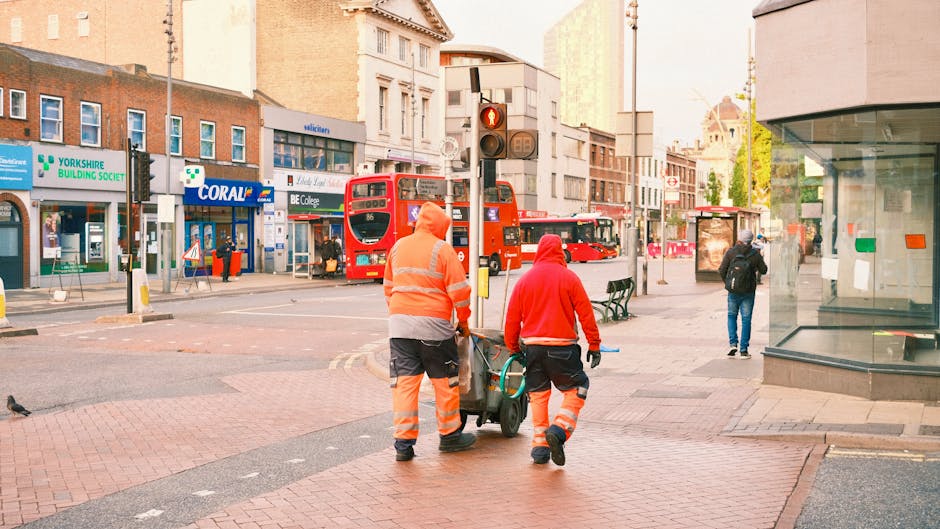
Commercial Block Paving Cleaning in London
Commercial block paving cleaning in London helps car parks, forecourts, access roads and paved entrances look cared for and perform as intended. Our work is centred on cleaning block paving surfaces with methods suited to the condition of the paving, the type of staining present and the finish the client wants to retain. We focus on practical results: removing built-up dirt, reducing the look of moss and algae, and improving the presentation of commercial hard landscaping without treating every surface in the same way.
Block paving used in business settings often has to cope with tyre marks, tracked mud, leaf litter, chewing gum, oil spots and the growth that collects in joints and shaded corners. A good clean is not just about making the surface look lighter. It is about restoring the usable character of the paving, keeping edges and joints easier to manage, and helping the whole frontage support a tidy first impression for staff, visitors and customers. We can also work around access needs where areas must stay open.
Because every paved area behaves differently, the right approach depends on the paving pattern, age, drainage, surrounding planting and how heavily the area is used. On some sites the priority is a broad wash-down and stain reduction; on others it is a more careful process that avoids disturbing jointing or spreading debris into nearby features. If you need a clear price and a sensible plan, tell us about the area and request a quotation.
Cleaning methods for commercial block paving
The most effective cleaning approach is the one that matches the surface and the site. Block paving can be robust, but it still needs a considered process. We look at the texture of the blocks, the level of soiling, and any fragile surrounding features before choosing how to clean. That keeps the work focused and helps avoid unnecessary disruption to the joints, the edging or adjoining planted areas.
For many commercial spaces, the main task is the removal of routine grime that accumulates over time. That may include dust, road film, mud, light weed growth and stains that settle into the textured finish of the paving. Where appropriate, cleaning can be combined with detailed attention to the joints and edges so the result looks even rather than patchy. Consistency matters across larger paved areas, especially when several approaches or bays meet one another.
Useful cleaning choices usually depend on a few simple factors:
- the size and layout of the paved area
- the amount and type of staining present
- the age and condition of the block paving
- drainage, runoff and nearby surfaces
- any need to keep entrances or vehicle routes accessible
Stain reduction and surface presentation
Commercial paving is often judged first by appearance, but not every mark should be approached in the same way. Oil, gum, rust-tinted deposits and general dirt each behave differently on block paving, and a responsible clean starts with understanding that difference. Some stains respond well to standard washing and brushing, while others need a more targeted method or may remain partially visible because they have penetrated the surface or settled into the pores of the blocks.
We aim for a clean, even presentation across the whole paved area rather than an isolated bright patch where one mark has been attacked too aggressively. That means the work is planned so the cleaned sections blend properly with the rest of the surface. On commercial sites this is important because uneven results can be more noticeable than a gentle, well-balanced finish. It is often better to improve the overall appearance by a sensible margin than to over-work one area and leave another untouched.
Surface presentation also includes the state of the edges, kerbs and transitions into other materials. A paved entrance can look neglected if the blocks themselves are clean but the perimeter still carries debris. Where needed, we can pay attention to these boundary areas as part of the wider clean. This is especially useful for forecourts and reception routes where customers notice the paved approach before they notice anything else.
Why block paving needs a tailored approach
Block paving is built from many separate units, which makes it durable but also means the finish can be affected by joints, compaction and surface wear. A method that is too forceful may disturb the sand in the joints or make an older surface look uneven. A method that is too mild may leave grime in the pattern and fail to improve the site properly. The aim is always to find the middle ground that suits the paving rather than forcing the paving to suit the method.
Commercial areas also vary in the way they are used. A service yard with regular vehicle movement does not have the same requirements as a paved seating area, and neither has the same pattern of dirt. Access routes may need a more practical clean focused on grip and presentation, while a customer-facing courtyard may call for a more refined finish. Context shapes the work, which is why one-size-fits-all cleaning rarely gives the best result.
Where a site has mixed paving, the cleaning plan can be adjusted so block paving is handled differently from adjacent slabs, gravel borders or planted areas. That helps keep the work accurate and avoids unnecessary overspill. It also means the cleaned section looks intentional and not merely washed at speed. For businesses that manage several outdoor surfaces, this attention to detail makes the result easier to maintain.
Access routes, entrances and high-use areas

In commercial settings, the main paved zones are usually the routes that see the most traffic. Entrance paths, loading approaches, customer parking bays and delivery fronts often build up dirt more quickly than secondary areas. Cleaning these spaces can improve the look of the whole property because they are the parts most people encounter first. A well-cleaned paved approach can make signage, glazing and landscaping appear more deliberate as well.
We can give attention to areas that are difficult to keep clean through ordinary sweeping alone. That may include corners where silt gathers, places near drains where residue collects, or stretches of paving shaded by walls, fencing or planting. The work can also be organised so that access is managed sensibly if the surface cannot be closed for long. Where needed, sections can be treated in a practical order so the site remains usable.
For busy properties, timing and sequencing matter almost as much as the cleaning itself. A clear route should not become a blocked route, and the cleaning plan should respect how the property operates day to day. That is why site-specific details help shape the quotation. If the paving is around visitor parking, a shopfront or a shared access lane, a short description of use and size is usually enough to begin planning.
Supportive maintenance for longer-lasting results
Block paving cleaning is often most effective when it is part of a wider maintenance approach rather than a one-off appearance fix. Regular upkeep helps prevent the heavy build-up of grime that can make later cleaning more involved. Keeping the surface free from debris, treating encroaching growth and managing spillages promptly all help the paving stay presentable for longer between deeper cleans.
In some cases, the condition of the joints and the edges is as important as the visible top surface. If sand has been disturbed or washed out, the paving can look less settled and can become harder to maintain. A sensible clean takes that into account and avoids unnecessary disturbance. Where a site needs more than washing alone, the quotation can reflect the extra care required rather than treating every area as if it were freshly laid.
Commercial clients often want a plan that fits routine servicing rather than a one-off appearance boost. The right schedule depends on traffic levels, the local environment and how quickly the paving attracts dirt. We can discuss cleaning as a single visit or as part of a wider upkeep pattern, always keeping the scope focused on the surface itself and the practical result the site needs.
What affects the quotation
The price of commercial block paving cleaning usually depends on straightforward site factors rather than a fixed formula. Area size, access, the heaviness of staining, the amount of weed or moss growth, and the complexity of the paving layout all influence the work involved. A simple open forecourt is different from a courtyard with tight corners, changes in level and limited drainage, so the quotation should reflect the actual conditions.
It is also sensible to consider what the client wants the clean to achieve. Some customers only need the paving to look tidier for visitors; others want a more thorough clean because the surface is part of a prominent frontage or shared business space. The right scope can be adjusted to fit that aim. If the paving includes areas that should be handled more carefully, those points can be noted before the work is priced.
When you ask for a quotation, it helps to describe the size of the paved area, the setting and any obvious staining. That allows the work to be matched to the real conditions and avoids vague assumptions. A brief note about whether the surface is open to vehicles, pedestrians or both is usually enough to start. Clear information leads to a clearer price and a more useful plan.
About London

London is a large and historically layered city formed along the River Thames, with a landscape that combines ancient routeways, royal and civic districts, docklands, suburban growth and modern redevelopment. Its origins reach back to the Roman settlement of Londinium, established in the first century, and traces of that long history remain in the street pattern and in landmark sites across the centre. The city’s identity has been shaped by centuries of trade, governance, migration and rebuilding, with each era leaving visible marks in stone, brick, steel and open space. The Thames remains one of the most defining features of the city, linking the waterfronts, bridges and riverfront walks that tie together areas once separated by industry or parish boundaries. Westminster contains some of the best-known national institutions, while the City of London preserves a smaller historic core with a distinct administrative role. Across the wider metropolis, boroughs and neighbourhoods range from dense inner districts to quieter residential quarters, each with their own built character. London’s parkland network is unusually extensive for a capital city, with major spaces such as Hyde Park, Regent’s Park, Hampstead Heath and Greenwich Park offering broad stretches of green amid the built environment. Architectural variety is one of the city’s most striking features: medieval churches, Georgian terraces, Victorian civic buildings, interwar estates and contemporary towers sit within a relatively compact urban fabric. Public transport has also shaped the city’s growth, from the Underground and rail termini to bus corridors and river crossings. Cultural life is equally varied, with museums, theatres, galleries, markets and performance venues distributed across central and outer districts alike. The result is a city that can feel formal and ceremonial in one place, animated and street-level in another, and historically resonant almost everywhere in between.
Commercial cleaning for business premises
Block paving around business premises rarely exists on its own. It usually forms part of a wider exterior composed of walls, railings, windows, planting, signage and paved thresholds. For that reason, a clean should support the whole frontage rather than compete with it. A careful result helps the paving sit naturally within the setting, so the site looks looked after without appearing over-processed or inconsistent.
We are often asked to focus on visible areas that influence how a property is perceived at ground level. That can include entrances, parking strips, shared paths and paved courtyards. These spaces benefit from a method that respects foot traffic, drainage and adjacent materials. If the paving sits close to decorative planting or lighter-coloured finishes, extra care may be needed to avoid splashing or residue. The goal is a neat, even surface that fits the property.
Supporting details can make a quotation more accurate without making the process complicated. A few notes about the paving’s location, how often it is used, and whether there are awkward access points are usually enough. If there is a deadline for an event, opening or inspection, that can be mentioned as well. We can then shape the work around the practical realities of the site rather than making assumptions. Good planning makes the clean easier to deliver well.
What to include when you enquire

A useful enquiry does not need to be long. The main points are the type of paved area, an approximate size, the sort of dirt or staining visible, and whether the area is mainly for vehicles, pedestrians or both. If there are sections that are difficult to reach, uneven, shaded or close to delicate features, it helps to mention those too. That information gives the quotation a proper foundation.
If possible, note whether you want a routine refresh or a more thorough clean. Those are not always the same thing. A routine clean may focus on general appearance, while a deeper service may need more time on stubborn deposits and neglected corners. Either way, the aim is to quote on the basis of the real work involved. Send the details through and ask for a quotation if you are ready to compare options.
For commercial clients, the simplest approach is often the best: describe the paving, the access, and the result you need. We can then respond with a clear proposal that reflects the surface in front of us rather than a generic package. If you want to keep the process moving, request a quotation and we will take it from there.
More ways we can help with exterior paving care
Commercial block paving cleaning is sometimes part of a wider programme of exterior care. On many premises, paving sits alongside patios, paths, decking, gutters or landscaped features that also need attention over time. Where the site includes several hard surfaces, it can be helpful to keep each one on a sensible maintenance rhythm so the property presents well as a whole. A coordinated approach can also reduce the contrast between cleaned and uncleared areas.
Our service pages cover a number of related outdoor works that may be relevant if your property needs more than block paving cleaning alone. These include pressure washing for suitable hard surfaces, driveway cleaning for access and parking areas, patio cleaning for paved leisure spaces, and decking cleaning where timber or composite boards need a different method. Each type of surface needs its own handling, so it is worth matching the task to the material.
Where the outdoor area has become heavily overgrown or cluttered, additional support may be useful before or after cleaning. For instance, garden clearance can help reset surrounding spaces, while garden maintenance can support a tidier finish around paving edges. If trees or shrubs are affecting the cleanliness of paved areas, tree surgery and hedge trimming may be relevant. The best results usually come from dealing with the setting as well as the surface.
Choosing the right service page
When a client is deciding how to approach exterior cleaning, the first task is often to separate the material from the location. Block paving needs a different method from slabs, timber decking, fencing or lawns, even when the same property includes all of them. That is why it helps to think in terms of surface type and condition rather than assuming one process suits every outdoor feature. The right service choice makes the result more dependable.
For larger properties, the most practical route may be to look at the whole exterior plan. A paved entrance may need cleaning, while the surrounding beds need maintenance and the adjoining hard surfaces need a different treatment. Related pages such as services overview, pricing and quotes, and contact us can help you move from a general idea to a specific request. If the work is focused just on the paving, keep the enquiry narrow and specific.
Whatever the scope, the aim is to make the process straightforward. Block paving cleaning should leave you with a cleaner, more presentable surface and a quotation that reflects the actual site. If the work is likely to involve several exterior areas, mention that at the outset so the right combination can be discussed. Otherwise, a single focused clean may be all that is required for the property to look much better.